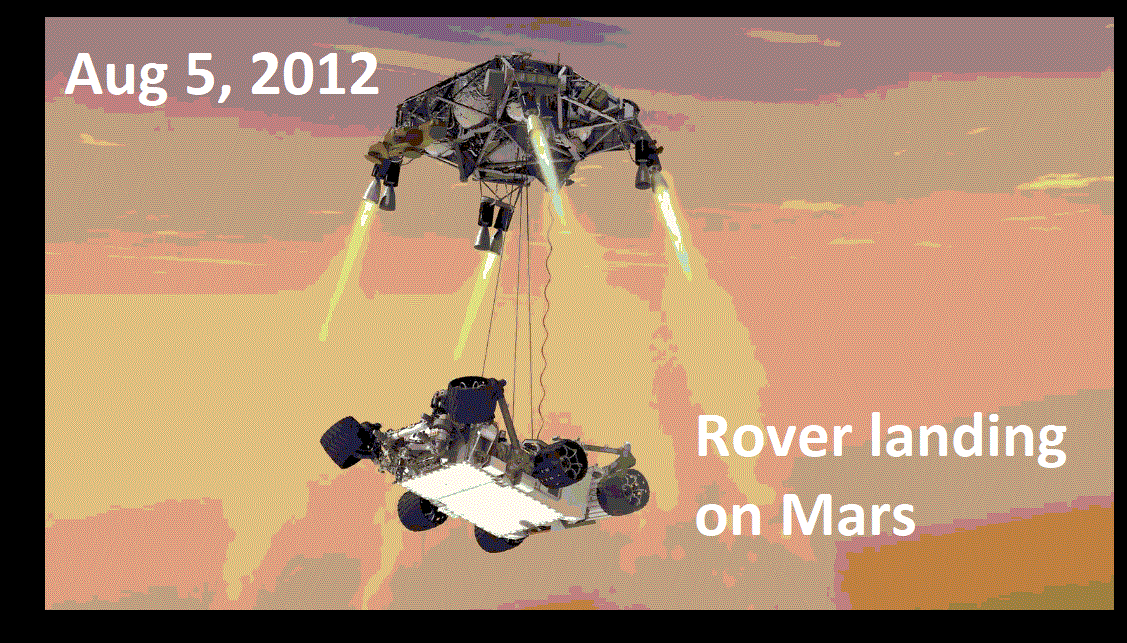
Introduction: In this Post we view School Library in Three Time-Compartments – with the second, Digitized and in a third time-bound compartment – AI in Libraries, (explorative)
This Draft is meant to initiate discussions / trigger possibilities
I. School Library – The Old View
Generally, School Libraries have been viewed as secondary, as source for supplementary Learning
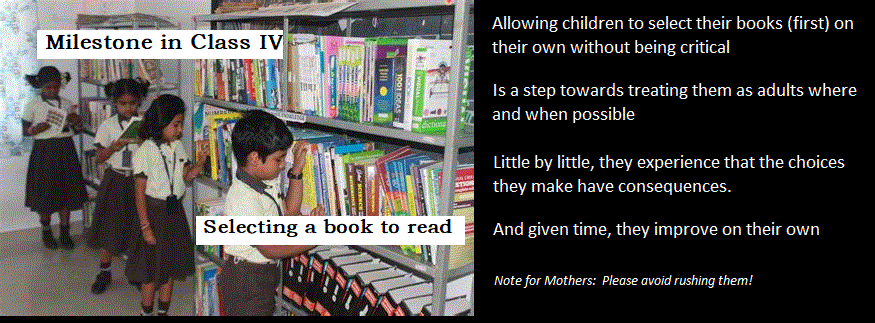
In the old view, Libraries were Windows to the World!
‘School libraries as engines of workforce and economic development’ – seems like the jingoisms some have acquired to promote facilities however good the intent. Here is another one.
‘The Workers of Tomorrow are sitting in the Classrooms of Today’ – well meaning perhaps but still a narrowed view of what schools are or meant to be.
If we, as all along believed that Libraries are not silos of knowledge but ‘window to the world’ and perhaps over time; to reflect on; then let us plough on.
Readers are welcome to recall their experiences from their first visit to the Library (school’s or otherwise)
‘Value Learning’ from a Good Book in the Library
Not the size or the Quantity of Books but the Quality and Ease of Access: (Anecdotal, from 1970s) It was in Class IX that we visited the Library – the room was annexed to the Principal’s Office There was hardly any time to familiarize with the books – many in glass fronted cupboards. A wide paged book on Physics caught my attention. It was expensive and unlikely that I may be allowed to borrow. I browsed through the initial pages and can recall the first chapter with a large diagram showing spherical balls of molecules – scaled up to size of ping pong balls – bouncing off the walls of the container. The chapter was ‘Kinetic Theory of Gasses’. There followed chapters including one on ‘jet engine plumes’. Much to my regret, I dared not to ask to borrow and returned it to the shelf.
Later, during working years when I came across problems such as annealing of weld joints for pressure vessels that became economical when instead of each joint, the entire vessel was heat treated and soaked uniformly at around 400 deg C with gas burners inside – that I wished I had asked for and borrowed that book.
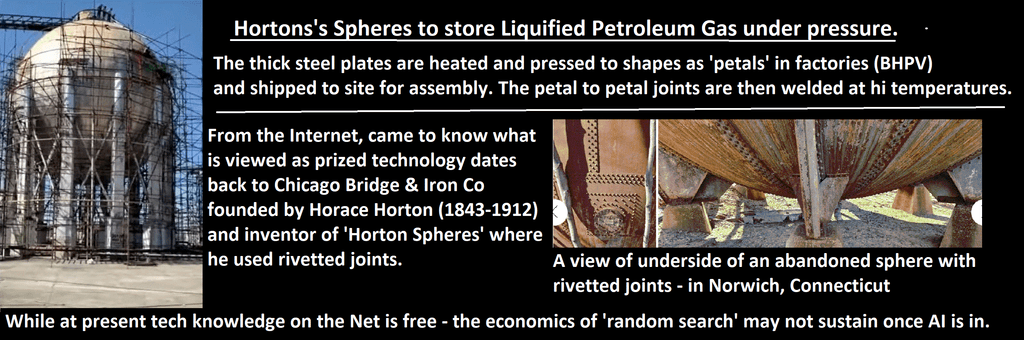
The Horton’s company soaks spherical vessels with a single internal gas burner
Picture Source: https://www.atlasobscura.com/places/norwich-horton-sphere
The Old View – There’s nothing like a good book to read at one’s pace and leisure
Textbooks on Sciences are not meant to bulk with large font size, illustrations and analogies that increase the print cost. They are meant to cover Definitions, Laws, Important Facts as well as Theories evidenced by experimental results with the Topics and Sections set in an Order of Learning. The problems at end-of-chapters are where ‘learning is acquired’ and may require adult assistance as they advance from worked out examples laying out procedures to real world applications as well as Corollaries, implicit in the Laws.
It is up to Teachers to improvise with Analogies appropriate to the their Class. In practise, not all are able to do justice except may be in the key topics. The reason commonly given is they have a vast syllabi to cover within the time available; and this is quite true.
Recommended Books: (For Middle and Higher Classes – we have developed a List – available on Request)
Library Walls may discretely present ‘Art walking hand-in-hand with Science’ or other inspirational posters. Here’s an example of Art without background clutter (Focussed)
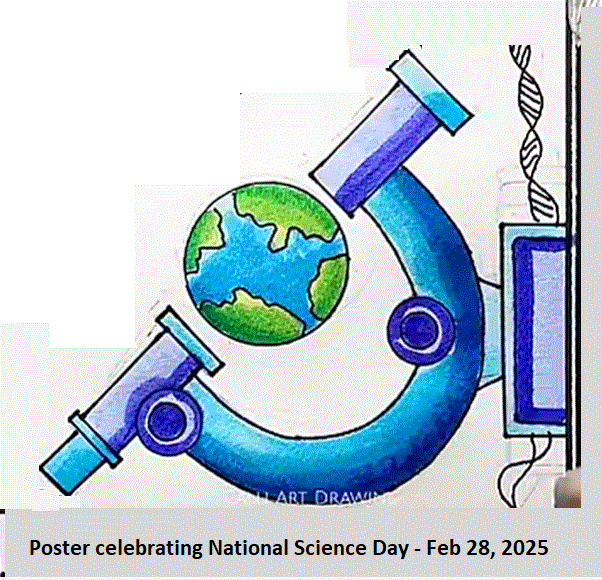
Source: Call Art Drawing – Youtube
The Video referred to ‘Call Art Drawing’ shows how the Poster was developed for National Science Day. May interest those, who believe that the DNA strand (the engineering of Life) shown on the right wall of the poster should have been given greater emphasis.
Part II – Digitized Library – Our Schools are here
Neatly describing services of their Digital Library we present an excerpt from Sarvajanik University below.
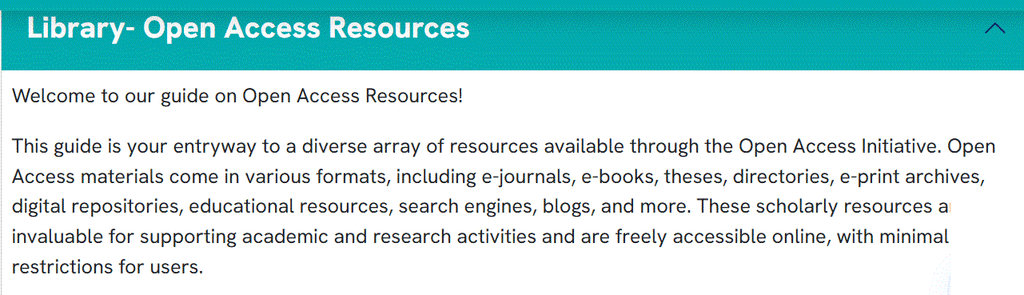
https://sarvajanikuniversity.ac.in/pages/central-library-sarvajanik-university/#gsc.tab=0
In general, it is about historical books and journals scanned to digital files as e-books and available freely to all across the internet.
Legacy: When Knowledge is understood over Timelines
While Sarvajanik’s Library functions as custodian of a treasuries of documents during the Freedom Movement; we generally overlook the value in ‘Knowledge across Timelines’. Here is an example from Physics – where we present a Concept walking with ‘Art and photograph’, over a Timeline

Can such illustrative works be developed to form a compendium for School Libraries? This would require retired professionals from across government and industry to pitch in – maybe even develop custom illustrations of their experiences – if such services were available at nominal or reasonable costs. Whether such sets of ‘experience-based-stories’ on humanities and sciences contain a certain amount of ‘value learning’ – is something a pilot project would tell. As a Case for Knowledge over Time Lines and the Value Learning derived from it , we presented an example below.
Example on Value Learning – also as Feedback to Math and Science Teachers: In the construction industry – where rigging and lifting loads by cranes is common, occasionally, accidents occur. Even simple jobs such as loading or unloading equipment from a trailer may destabilize the trailer. While the average worker is agile enough to learn on the job, accidents recur as and when new teams come in.
To give a sense of what we are getting at: For heavy loads, supervisors or engineers (even some with experience) are unable to scale problems on paper – apply fundamentals such as parallelogram of forces and trigonometry for the components. Quite often, the horizontal component is overlooked and slings tend to slip (slings made of wire rope are utilized in varying forms – sometimes turned around a large girder beam to get a grip – like coils of a snake). In most cases, while guy-ropes are used to correct any imbalances during a lift – each Lift goes up on prayer and Legacy of senior rigger – rarely by an engineer retrained or certified for critical lifts.
In other words, accidents occur in the field because we are unable to apply fundamental principles of sciences on the job. (To a certain extent industries are also at fault here – not taking initiatives to interact with local communities and their schools – to send students for ‘industrial orientation’ or summer vacation internship and so on.)
Proposal: Repurpose Digitized Libraries
We see schools providing training on ‘IT Coding’ or Web Page designing (which is ok); hardly do we find programs to supplement what is already learnt in Sciences or Humanities. Libraries could play a role in developing a compendium of such programs. (Retd. government and industry professionals may volunteer / coordinate programs).
Part III: The Library with AI – staging differences in near future
Let us begin with what ‘we think’ on how AI may benefit the Library – with a Comparison chart
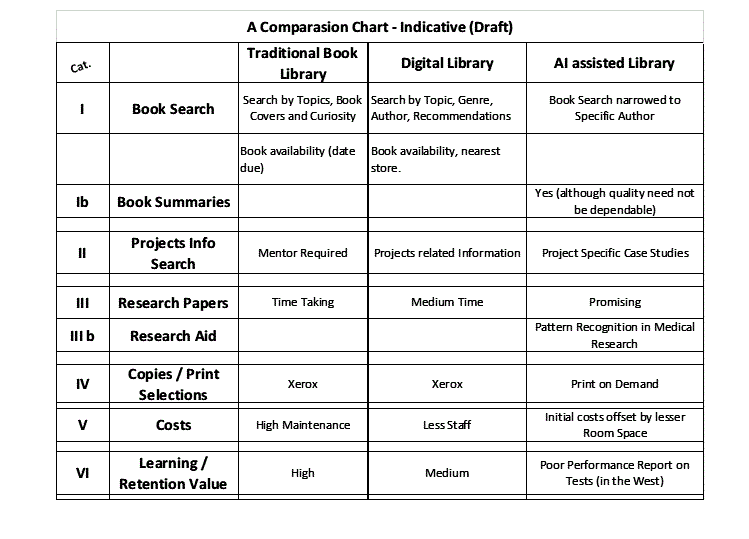
AI Summaries: If an AI Agent say Chat GPT, can ‘Summarize’ a book and present the key findings to us (even with some inaccuracies); – can we view it on par with our cognitive intelligence? (Controversies abound because such a view would mean that the ‘Artificial’ is no longer artificial but has to it, some degree of ‘life’ and consciousness!)
Sam Altman of ChatGPT fame reportedly said, ‘We see a future where intelligence is a utility like electricity or water and people buy it from us on a meter.
If we go by Mr Altman’s business view then an AI centric Library with it’s shared costs appears as a fair proposition.
The Case for AI in Libraries
An enhanced View, advancing beyond the ‘Utility View’ is presented in the following Cambridge Paper.
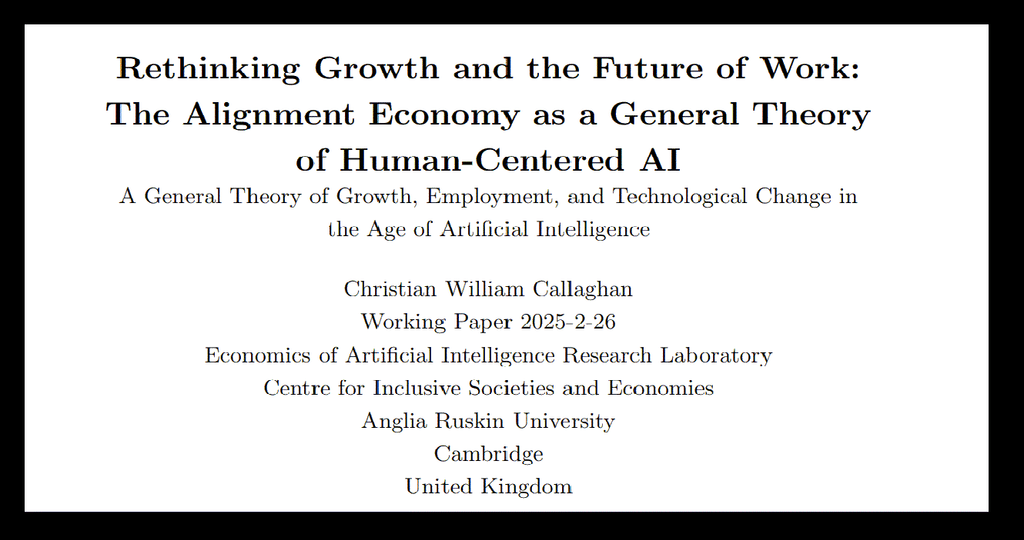
The Paper introduces Experiential Matrix Theory (EMT) as a transdisciplinary framework that
redefines economic progress not as growth per se (GDP measures); but as the dynamic alignment between production systems and an evolving, socially mediated matrix of human experiential needs. A bridge between quantitative economic modelling (productivity / efficiencies) and theories on ‘human flourishing’.
The Paper also cautions us that the transition to more mature AI economics and ecology will take time. ‘AI-driven production systems learn over time to align with utility-bearing dimensions that conventional markets often ignore, such as community, purpose, environmental stewardship, and dignity.’
Whether AI systems of the future are ‘capable of detecting and thereby recasting joblessness not as an economic equilibrium but as a failure of alignment’ – is in our frank view a toss up. It may suit and serve Western interests with their advanced healthcare and insurance and many other well-beingness programs already structured into their economies but in a developing country like ours – it remains a toss up.
While an AI-mediated world is here to stay ..
Obviously, as Nations race for AI dominance with their policies that whoever controls AI controls the World, militarily and economically; we in India are weighed down with not merely poverty but the core problem the size of which the Census of 2027 shall reveal.
Yet, paradoxically; AI may lay the path for collective elevation through innovations in areas that appear fuzzy at present and are the feature topics of our Posts on this Site and what better way to test this hypothesis on Innovation than to use our Libraries as Testbeds for AI?
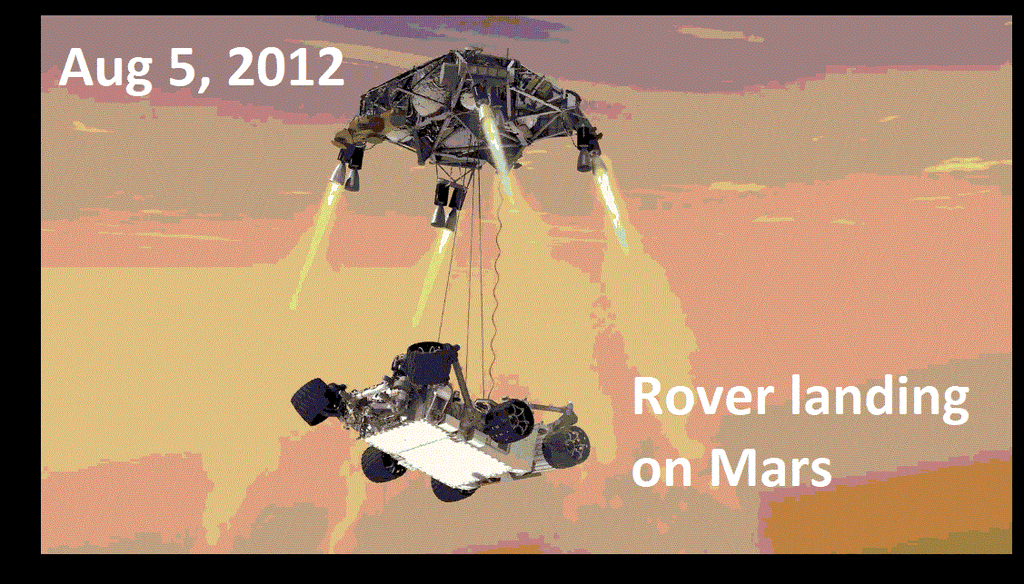
Another view we may explore is whether AI may generate a Bigger Picture drawn from inter-disciplinary studies. While this topic is vast – we leave our readers with another Big Picture of AI in Space Travel.

More on this when occasion permits.
Thank you.
Chennai, 30 August 2026
AI in School Libraries
